
Skip to main content Scroll Top
Ghana Post Digital Address: GA-018-1233

Annual Lecture in the Sciences

ibok 1

12 Jun: Indigenous Foods Hold the Key to Africa’s Food Security, Says Prof. Ibok Oduro

Prof. (Mrs.) Ibok N. Oduro, FGA, Professor of Postharvest Technology at the Kwame Nkrumah University of Science and Technology (KNUST), has called for increased investment in indigenous food research, value addition and policy support to unlock the potential of Africa’s traditional crops.

She made the call while delivering her Inaugural Lecture in the Sciences at the Ghana Academy of Arts and Sciences (GAAS) on Thursday, 11 June 2026, at the Academy’s Secretariat in Accra. During the lecture, Prof. Oduro described Africa’s indigenous foods as a “hidden harvest” with immense potential to address food insecurity, malnutrition, climate challenges and economic development across the continent.

prof-agyei-mensah

19 Oct: Prof. Agyei-Mensah Calls for Multi-Scale Approach to Evaluating Water Access in Ghana

Ghana is unlikely to meet SDG 6 by 2030, particularly targets 6.1 and 6.3 which focus on universal access to safe and affordable drinking water and improving water quality, respectively. Prof. Samuel Agyei-Mensah, FGA, raised this concern during his inaugural lecture on the topic, “Flavours of Spatial Diversity in Drinking Water Access in Ghana,” held on October 17, 2024, at the Ghana Academy of Arts and Sciences (GAAS) in Accra.

GAAS logo

12 Jan: GAAS Report of Activities for 2023

In 2023, the Academy held its 3 flagship programmes as follows:

1. The 56th J. B. Danquah Memorial Lectures took place from 20 – 22 February 2023 on the theme “African Politics and the Mystical Realm: Religion and Governance in Ghana” by Rev. Professor J. Kwabena Asamoah-Gyadu, FGA and President of the Trinity Theological Seminary, Legon.

Blood Sugar6

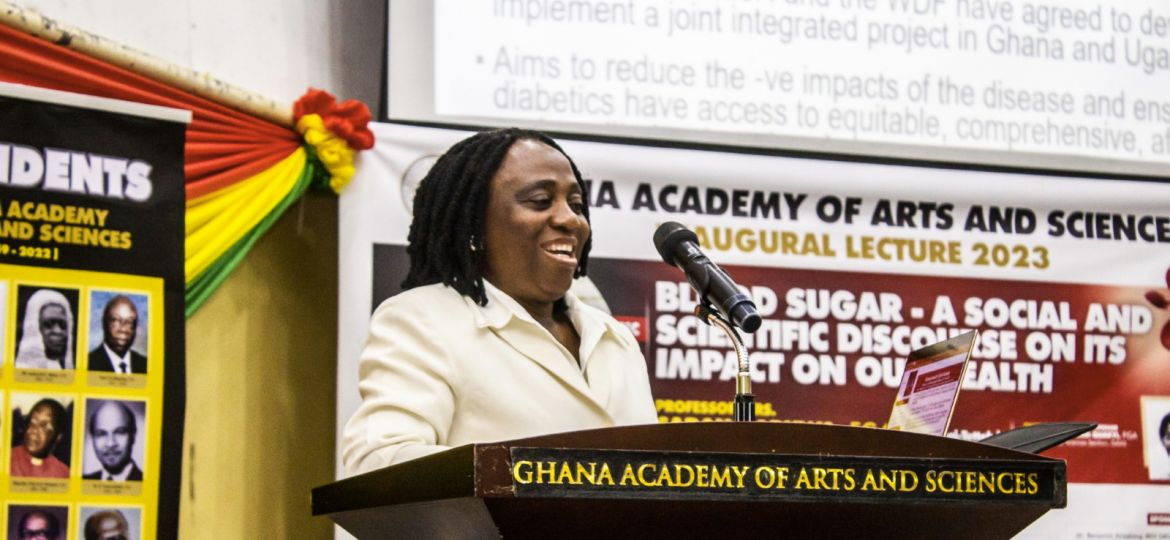
12 Oct: Inaugural Leture 2023 – Blood Sugar

Food and Public Health are inseparable. We talk about food in terms of safe food, healthy food, junk food, unhealthy food, and ultra-processed food. The healthiness of food (or lack thereof) is influenced by multiple factors including food marketing, food fraud, food policy, food politics, food justice, food democracy, and food environments. Of equal importance are the impacts of unhealthy food on human health and planetary health. Such impacts include hunger, and diet-related non-communicable diseases (NCDs) – obesity, hypertension, stroke, ischemic heart disease, and diabetes.